
After an Online Color Blind Test: When to See an Eye Doctor
2026-03-18 · Jamie Chen · 11 min read
TL;DR: Online screening is a start—not a diagnosis. Know when to book a clinical color vision exam.
You just took an online color blindness screening test. The results came back, and now you’re wondering: what does this actually mean? Do I need to see a doctor? Should I get a professional evaluation?
If you’re asking these questions, you’re already thinking like someone who takes their eye health seriously. The truth is, online screening tests serve a real purpose, but they have real limits too. They’re a helpful first signal, not a final diagnosis. Knowing when to take the next step with a professional eye care provider can make all the difference in understanding your color vision and protecting your overall eye health.
Let me walk you through what online tests can and can’t tell you, and exactly when you should schedule an appointment with an optometrist or eye specialist.
What an online color blindness screening actually measures
Before you can decide whether to seek professional testing, it helps to understand what you actually just took.
Most online color blindness screenings, including Ishihara-style plate tests, are screening tools. They’re designed to quickly flag whether someone might have a color vision deficiency. They work by showing you patterned dots or numbers hidden in colored backgrounds. If you can see the pattern, your color vision is likely normal. If you can’t, that’s a red flag worth investigating further.
The key word here is “flag.” A screening test is a starting point, not a conclusion.
Here’s why that distinction matters: online tests run in your web browser on your personal computer or phone. They depend on several factors you can’t fully control.
Your screen’s color calibration affects the accuracy significantly. A laptop with poor color reproduction, a phone screen that’s been exposed to sunlight, or even the brightness settings you’ve adjusted will change how the test colors actually appear to you. Professional color blindness testing uses standardized, calibrated equipment and controlled lighting conditions specifically designed to eliminate these variables.
Additionally, online tests can’t measure severity. Some people have partial color blindness, where they struggle with color discrimination in certain lighting conditions or specific hue ranges. Others have complete color blindness in one or both color channels. A screening test can suggest you might have deuteranopia (green-blindness) or protanopia (red-blindness), but it can’t tell you whether your version is mild, moderate, or severe. That level of detail requires professional equipment and expertise.
Online tests also can’t rule out other eye conditions that look like color blindness but actually stem from something else. Cataracts, age-related macular degeneration, diabetic retinopathy, and even certain medications can impair color discrimination. A professional eye care provider can distinguish between true color vision deficiency and color confusion caused by other eye diseases.
Red flags that mean you should see a professional now
Some situations call for scheduling an appointment with an optometrist or ophthalmologist sooner rather than later.
You failed the screening test and you’ve never had your color vision formally tested. If this is your first time discovering you might have color blindness, a professional evaluation gives you a baseline and confirms what type of CVD you have (or whether it’s something else entirely). This matters for your medical record, your career planning, and your understanding of yourself.
Your result surprised you or doesn’t match your real-world experience. You know how you see colors in your daily life. You know whether traffic lights make sense to you, whether you struggle with red and green, or whether you’ve never had trouble until now. If the online test result contradicts your lived experience, that’s a signal to get a professional opinion. You might have taken the test under non-ideal conditions, or there might be an underlying eye condition affecting color perception.
You’re experiencing any other vision changes alongside the color blindness screening result. This could include blurriness, floaters, light sensitivity, or difficulty seeing in dim light. Color vision problems combined with other vision symptoms can indicate cataracts, retinal disease, or optic nerve damage. These conditions need professional evaluation and possibly treatment.
You’re applying for a job or role where color discrimination is legally required. Pilots, commercial drivers, electricians, and medical professionals often need documented, certified color vision testing. An online result won’t cut it. You’ll need professional testing from a licensed eye care provider, and the results will typically be recorded in a standardized format that employers and licensing bodies recognize.
You have a family history of color blindness or inherited eye disease. If your parents, siblings, or other close relatives have documented color vision deficiency, genetic eye disease, or progressive vision loss, that context matters. A professional can conduct more thorough testing and monitor you over time. It also helps establish a family history baseline for your own children.
You’re noticing changes in your color vision over time. Color blindness itself doesn’t change (you’re born with it or you’re not), but acquired changes in color perception can signal eye disease or systemic health conditions. If you used to distinguish colors fine and now you’re struggling, that’s worth a professional conversation, even if an online screening came back normal.
Your screening result is inconclusive or borderline. Some people hover near the cutoff on online tests. They might get inconsistent results depending on which test they take. That ambiguity is exactly what a professional is trained to resolve using rigorous, calibrated protocols.
What to expect from professional color blindness testing
If you decide to schedule an appointment (which I’d recommend for any of the red flags above), here’s what you’re likely to encounter.
Your eye care provider will start with a conversation about your vision history. They’ll ask whether you’ve noticed color discrimination issues, whether anyone in your family has color blindness, whether you’ve had any eye injuries or diseases, and what brings you in today. This context helps them interpret your test results accurately.
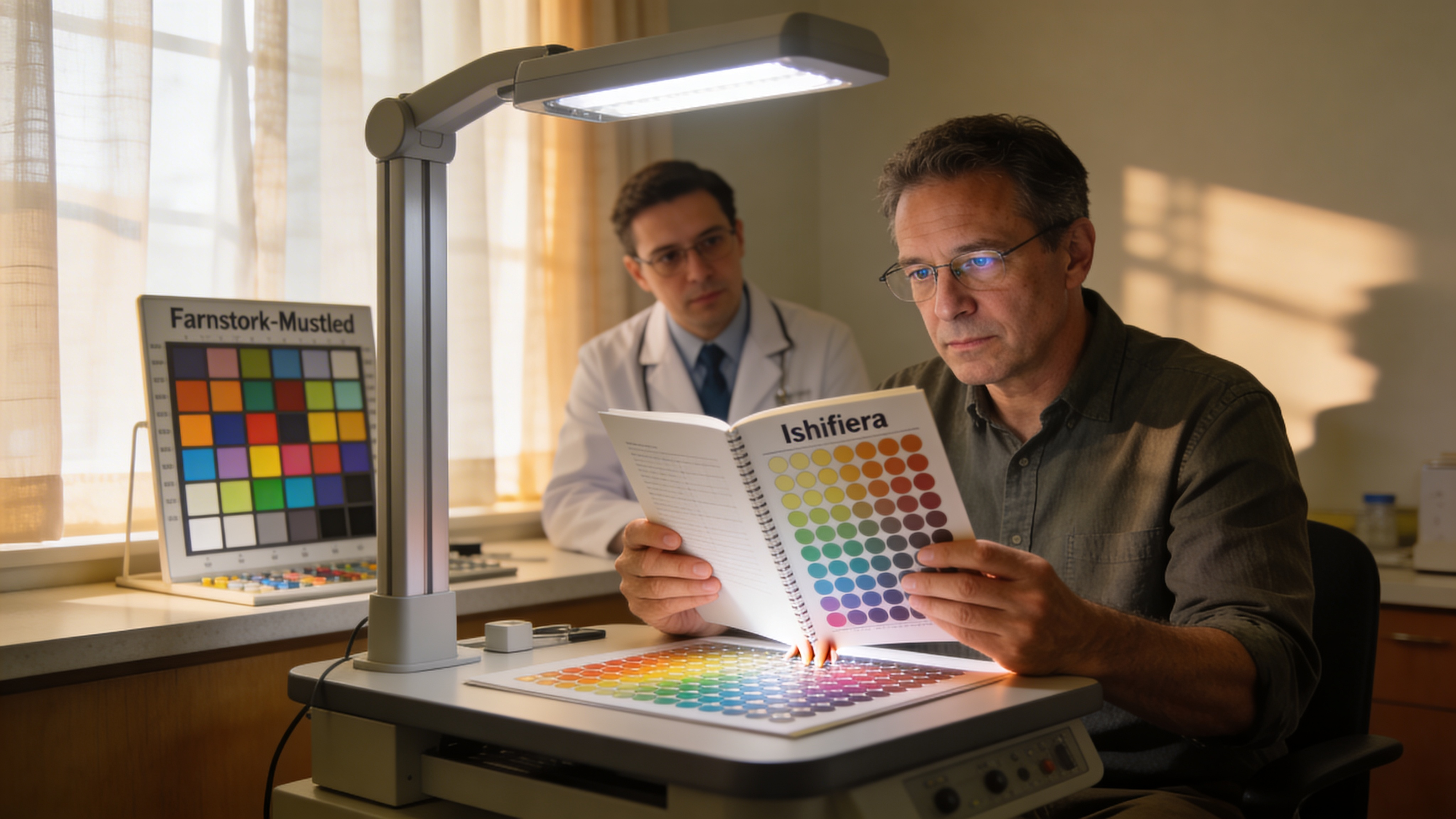
Then comes the actual testing. The most common professional color blindness test is an expanded version of the Ishihara plates you might have taken online. But a professional administers it under controlled lighting (usually a standardized viewing booth) with calibrated color plates. You’ll sit in the same position, view the plates at the same distance, and the clinician will record your responses without time pressure or rushing.
Some practices use the Farnsworth-Munsell test, which involves arranging colored caps in order of hue. This test is actually more sensitive to mild color vision deficiency and can catch subtle discrimination problems that plate tests might miss. Other clinicians might use the Lantern test, especially if they’re evaluating someone for safety-sensitive work like aviation or maritime roles.
A comprehensive professional evaluation might also include:
- Visual acuity testing: Making sure you can see clearly at distance and near, which affects how color discrimination tests are interpreted
- Pupil and eye movement checks: Ruling out neurological issues that could affect color perception
- Eye pressure measurement: Screening for glaucoma, which can damage color vision
- Retinal examination: Looking directly at the back of your eye to spot any signs of disease affecting the color-sensing parts of your retina
- Color vision testing specific to your job requirements (if applicable): Some employers or licensing bodies require particular testing protocols
The whole appointment usually takes 30 to 60 minutes, depending on what your provider needs to rule out or confirm.
Most importantly, a professional can tell you not just what you have, but why you have it and whether it’s stable, progressive, or something else entirely. They can also discuss whether your color vision deficiency affects your safety, your job, or your daily life, and what accommodations might help.
Where to go for professional testing
Your primary care doctor is a fine starting point if you need a referral, but they typically won’t do the testing themselves.
Optometrist: Licensed optometrists are trained to perform comprehensive eye exams, including color vision testing. Many insurance plans cover color blindness screening as part of a routine eye exam. Optometrists can diagnose color vision deficiency and refer you to a specialist if complications or other eye diseases are suspected. They’re also well-positioned to discuss practical accommodations or design strategies if you work in a field affected by color blindness.
Ophthalmologist: A medical doctor specializing in eye disease and eye surgery. Ophthalmologists can perform all the same color vision testing as optometrists, plus they can diagnose and treat eye diseases that might be causing color vision problems. If your online screening result came alongside other vision concerns, an ophthalmologist is the right choice.
Occupational medicine specialist or aviation medical examiner: If you’re seeking testing for a specific job or certification, ask your employer or licensing body whether they have an approved testing provider. Pilots, commercial drivers, and other safety-critical roles often have standardized evaluation paths.
If you don’t have an eye care provider, you can find one through:
- Your insurance company’s provider directory
- The American Optometric Association (if you’re in the US)
- A local hospital’s ophthalmology or optometry department
- Your primary care doctor’s referral network
Timing: should you make an appointment right away?
The urgency depends on your specific situation.
Schedule within the next week or two if:
- You failed a color blindness screening and you’ve never had professional testing before
- You experienced sudden changes in color vision
- You’re preparing for a job or licensing application that requires formal testing
- You have concerning symptoms alongside the screening result
Schedule within the next month if:
- You got an ambiguous or borderline result
- You want a professional baseline for comparison
- You’re planning to start a job where color discrimination matters
Schedule at your next routine eye exam if:
- You passed the online screening test but want to rule out other eye conditions
- You’re just curious and want confirmation
Don’t let a low-priority online result anxiety you into panic. But don’t dismiss it either. Think of it like the difference between a home blood pressure check and a clinical measurement. The home check is real data, but it’s useful primarily as a prompt to get the professional measurement if anything looks unusual.
Common questions about the next steps
Will professional testing be expensive?
If you have vision insurance, color blindness screening is usually covered as part of a routine eye exam (typically a $100 300 copay or out-of-pocket cost, depending on your plan). If you’re uninsured, a comprehensive eye exam runs $150 300 at most optometry practices, and some community health centers offer sliding-scale fees. If you need testing for a safety-critical job, your employer or licensing body sometimes covers the cost or provides approved low-cost testing sites.
What if I can’t afford professional testing right now?
That’s real. In the meantime, you can use free tools to understand how your color vision affects your daily digital life. Online simulators let you upload images or website screenshots to see how they appear through different types of color blindness filters. This gives you practical insight while you’re saving for or arranging a professional evaluation.
Will a professional test give me a different result than the online test I took?
Possibly. The online test was a screening; the professional test is a diagnostic evaluation. The professional result is far more reliable because of controlled conditions and calibrated equipment. Sometimes people get different results because the online test conditions weren’t ideal (screen calibration, lighting, time pressure), or because the professional testing is simply more thorough and precise.
Is there any treatment for color blindness?
True inherited color vision deficiency (protanopia, deuteranopia, tritanopia, achromatopsia) is genetic and permanent. There’s no cure. However, if an eye disease or medical condition is causing your color vision problem, treating that underlying condition might improve color perception. This is another reason professional testing matters: it can distinguish between genetic color blindness and acquired color vision problems that might be reversible.
If I’m color blind, will it get worse over time?
Genetic color blindness is stable; it doesn’t progressively worsen. But acquired color vision changes (caused by disease, medication, or aging) can worsen if the underlying cause isn’t managed. A professional can help you understand which category you fall into and what to monitor.
Taking action
An online color blindness screening is a useful starting point. It’s free, it’s quick, and it can prompt you to think about something you might not have considered before. But it’s not a substitute for professional evaluation, especially if you’re experiencing symptoms, applying for a job, or just want to understand your eyes in depth.
The decision to seek professional testing comes down to one simple question: does this result matter enough to you to get a definitive answer? For career reasons, for medical completeness, for peace of mind, or just for knowledge - that’s your call. But if any of the red flags above applied to you, the answer is yes.
Take your online screening result seriously enough to act on it, but not so seriously that you panic. Use it as data, use it as a prompt, and when in doubt, reach out to an optometrist or ophthalmologist. They’re trained to sort out what’s real color blindness, what’s something else, and what it means for your specific situation.
Need clarity before your appointment? Take our free Ishihara-style color blindness test again under ideal conditions (good lighting, calibrated screen), and if the result is consistent, bring that information with you when you see your eye care provider.
Related articles
- How to use a color blindness simulator (for images & websites)
- What does it mean to be colorblind? Types and differences explained
- Accessibility tools roundup for designers & developers
FAQ
How accurate are online color blindness tests?
Online screening tests are reasonably accurate at detecting whether someone might have a color vision deficiency, typically flagging 70 85% of true cases correctly. However, they depend heavily on screen calibration, lighting conditions, and browser color reproduction, which vary widely. Professional tests in controlled environments with calibrated equipment are significantly more accurate (95%+) and can also detect the type and severity of color blindness.
Can I fail an online test and still have normal color vision?
Yes. Poor screen calibration, glare, incorrect brightness settings, or even stress and fatigue can cause false positives on online tests. This is especially common on older monitors or cheap phone screens. If your online result contradicts your real-world experience (you’ve never had trouble seeing traffic lights or colors at work), a professional evaluation will clarify whether you actually have color blindness or whether the test conditions were suboptimal.
Do I need a referral from my doctor to see an optometrist?
No. In most cases, you can schedule directly with an optometrist without a referral. However, if you want your insurance to cover the visit, check your plan’s requirements. Some plans do require a referral to a specialist; others cover routine eye exams without one. Call your insurance company or the optometry office before scheduling to confirm coverage.
Will my insurance cover professional color blindness testing?
Most vision insurance plans cover comprehensive eye exams (which include color vision testing) as a preventive service, usually fully covered or with a copay of $10 50. If you’re uninsured or have a high-deductible plan, you’ll typically pay out-of-pocket ($100 300 for a full exam). If testing is required for a job or license, your employer or the licensing body sometimes covers the cost.
How often should I get professional color vision testing?
If you have genetic color blindness, once is usually enough unless you’re entering a new profession or licensing body that requires updated documentation. If you have acquired color vision changes (caused by disease or medication), your provider might recommend annual or biennial testing to monitor progression. If you have other eye diseases, regular color vision monitoring may be part of your ongoing care plan.
Get a clear picture of your own color vision with DeficiencyView’s free color blind test - Ishihara-style results in under two minutes, no login required.